
Six technology companies showcased solutions for financial research, wealth management, consumer insight and security to investors and institutions.
Updated
November 14, 2026 11:54 PM

Arnold Lau and King Leung (back row, fourth and fifth from left), Associate Directors-General of Investment Promotion at InvestHK, join the Ventureport team and representatives from the six technology companies. PHOTO: VENTUREPORT
Ventureport hosted the soft launch of InvestHK’s Fast-Track Connect at its AI+ Tech+ Finance+ gathering on 30 October, bringing more than 100 guests to Pier 1929 in Wan Chai.
Sponsored by InvestHK, the event brought investors, institutional representatives and technology companies together to explore investment and business partnerships. Six companies took the stage to showcase software solutions for financial professionals, consumer research, local AI computing and digital asset security.

The Acting Head of Startups, at InvestHK, Chin-yung (CY), and the Senior Vice President (Fintech), Pauline Fan, introduced Fast-Track Connect. They explained how the agency’s international network connects it with technology companies seeking investment, customers and business opportunities in Hong Kong.

Their remarks also highlight the need for a more structured approach to build these connections. Investors need easier ways to identify companies that match their interests, while institutions seeking new technology need access to businesses whose products could support their operations or benefit their customers.
To address this need, Fast-Track Connect provides an online platform where technology companies can publish profiles outlining their products and funding needs. Investors and corporate participants can identify relevant businesses and contact them to explore potential investments or collaborations. Service providers and community partners are also part of the platform. Alongside investors and corporate participants, these groups are designated as Champions on the platform.
Curated by InvestHK and supported by the Financial Services and the Treasury Bureau, Fast-Track Connect builds on the Global Fast Track Programme. It aims to help local enterprises expand into Chinese Mainland, Southeast Asia and other markets.

AlphaPai, an AI-powered investment research platform developed by financial technology company RabyteTech, presented tools for financial research, including gathering data, monitoring financial instruments and comparing information from corporate earnings calls.

At the event, the team explained how users can give research instructions in everyday language, while the software retrieves and processes information to prepare reports and presentation materials. Examples included tracking market developments and comparing company statements over time. The team also emphasised the importance of traceable sources, allowing analysts to verify the information behind their research.
A2B2.AI, a fintech startup, presented AI- powered tools designed to support investors and wealth advisers. Its specialist AI agents—software designed to carry out particular tasks—help prepare client meeting briefings, monitor financial products approaching maturity and identify market developments relevant to individual clients, according to the team.

For investors, the tool can help make sense of lengthy documents provided by advisers and bring information from different accounts together to assess risk exposure. For wealth professionals, the tools support preparation and follow-up around client meetings.
The team described its approach as combining AI with human expertise to support financial decision- making. It also clarified that the platform does not execute investment transactions on behalf of clients, leaving those decisions and actions in their hands.
Preferences AI, an AI startup specialising in synthetic consumer research, presented simulated consumer profiles that businesses can use to explore how different audiences might respond to products, pricing and marketing messages. These profiles generate modelled responses rather than feedback from people directly interviewed or surveyed.

The company described that its profiles are grounded in population data and account for differences between local audiences Businesses can use them to explore pricing or packaging options, as well as ask follow-up questions to understand the reasons behind a particular response. The team also discussed testing its models and working with academics to help validate the approach. It said the technology could help businesses explore consumer preferences more quickly.
ByteFuture, an AI infrastructure startup, focused on running AI on users’ own hardware. It introduced Olares, its operating system, and Olares One, a device designed to run AI models and applications locally.

Its applications included personal assistance, financial research and content creation. The team argued that users handling private documents or proprietary trading strategies may prefer to retain that material on equipment they control.
A demonstration of AI-generated video illustrated creative work the team said could run locally. It also described applications and agents available through its software marketplace.
PureGlobal, a fintech company, addressed digital asset custody: the systems used to safeguard access to digital assets. Its team described technology for protecting access credentials and supporting offline transactions without a conventional internet connection.

The presentation focused on infrastructure for institutions holding and transferring digital assets, including security under different operating conditions.
SlowMist, a blockchain security firm, examined the risks of giving AI agents permission to read information and perform tasks. Its examples included malicious instructions concealed in material an agent might encounter and attacks exploiting access granted to software.

The team discussed security auditing, monitoring and investigations alongside risks arising from third-party tools and an agent’s stored information. One scenario involved exposing a wallet’s recovery phrase, which can give someone control over its assets.
Keep Reading
The Hong Kong startup combines 3D-printed reef tiles, biodiversity monitoring and long-term data to help companies manage their impact on marine ecosystems.
Updated
August 18, 2026 11:32 PM
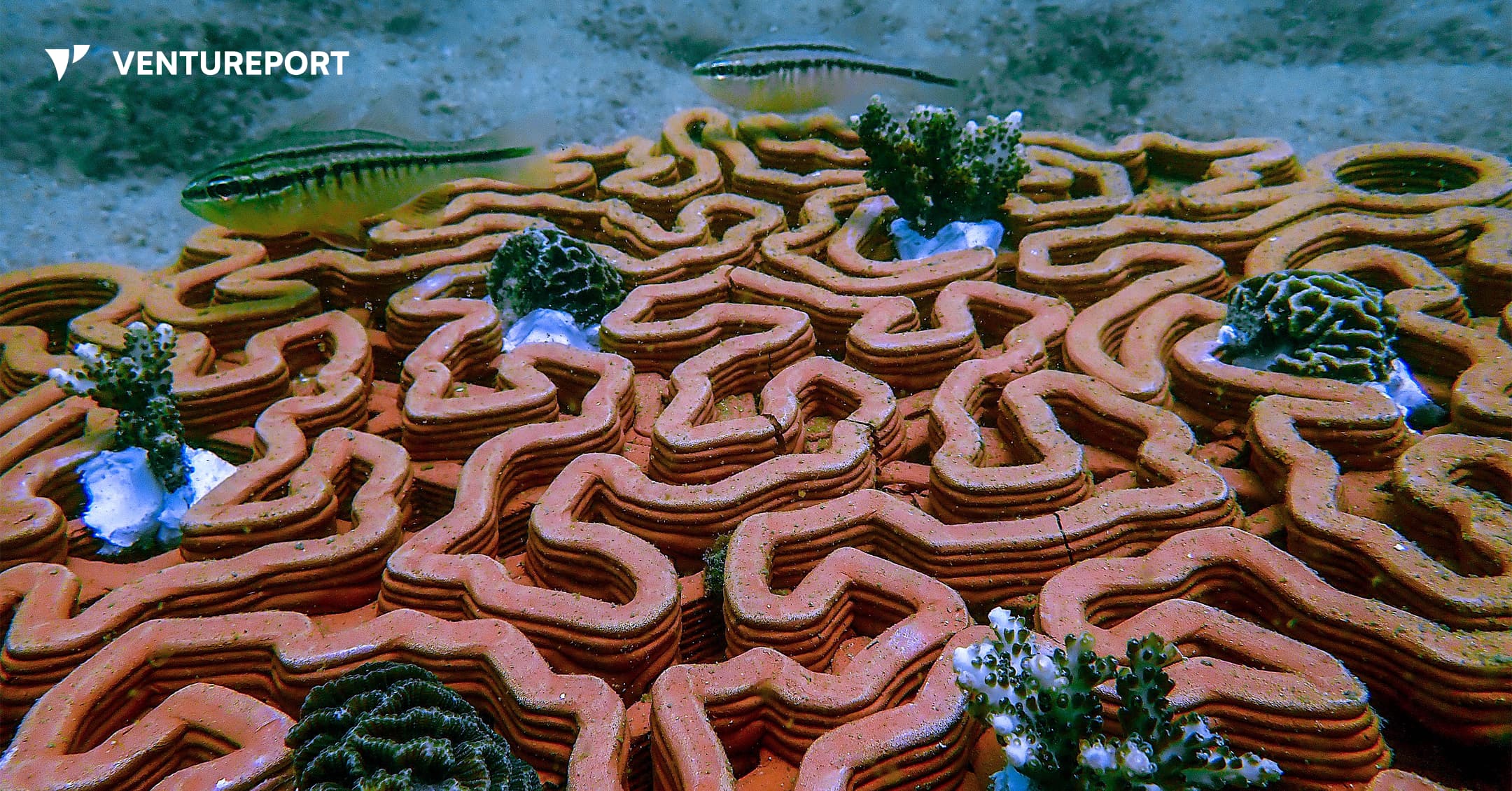
Young corals growing on Archireef's 3D-printed terracotta reef tiles beneath the sea. IMAGE: ARCHIREFF
Anyone who has snorkeled over a coral reef has probably admired its vibrant colours and the marine life swimming between its branches. What is less visible is how easily these ecosystems can be damaged. Rising ocean temperatures and pollution continue to put reefs under pressure, while coastal development creates another threat. Construction can stir up sediment that settles on corals, blocking the sunlight they need and making it harder for damaged reefs to recover.
Protecting marine ecosystems is becoming a shared responsibility. Alongside scientists, governments and conservation groups, businesses whose operations affect the ocean are increasingly expected to understand, manage and reduce their environmental impact. They must also show regulators, banks and investors that they are meeting their environmental commitments.
Archireef helps businesses meet those demands. Founded by Vriko Yu, the Hong Kong-rooted B2B startup specializes in marine ecosystem restoration and ocean nature risk management. Drawing on years of research at the University of Hong Kong, Yu built the company to help organisations understand, measure and reduce their impact on marine ecosystems.
Yu describes Archireef as an “end-to-end ocean nature risk management company”.
“What we offer them is a credible way to meet those obligations and stand behind the results,” she says.
One of the company’s main tools for restoring damaged marine ecosystems is its flagship 3D-printed terracotta reef tile. The tiles provide a stable foundation where young corals can attach, grow and survive over time.
Archireef chose terracotta instead of concrete and other conventional materials because it is pH-neutral and does not release harmful chemicals into the water. Its surface also gives corals a suitable place to attach naturally.
Before placing a single tile in the ocean, the team studies the proposed restoration site to determine whether recovery is possible. It assesses the water quality, biodiversity and general health of the ecosystem. As Yu explains, restoration should begin only where nature has a realistic chance to recover.
“Restoration isn’t about replacing nature or engineering a reef into existence. It is about removing the barriers and giving a degraded system the conditions it needs to begin recovering on its own”, she says.
Once the team selects a site, divers carefully place the tiles on the seabed. Their curves, ridges and crevices imitate the structure of a natural coral reef, creating sheltered spaces for marine species. The design also helps limit sediment build-up, which can block sunlight and smother young corals.
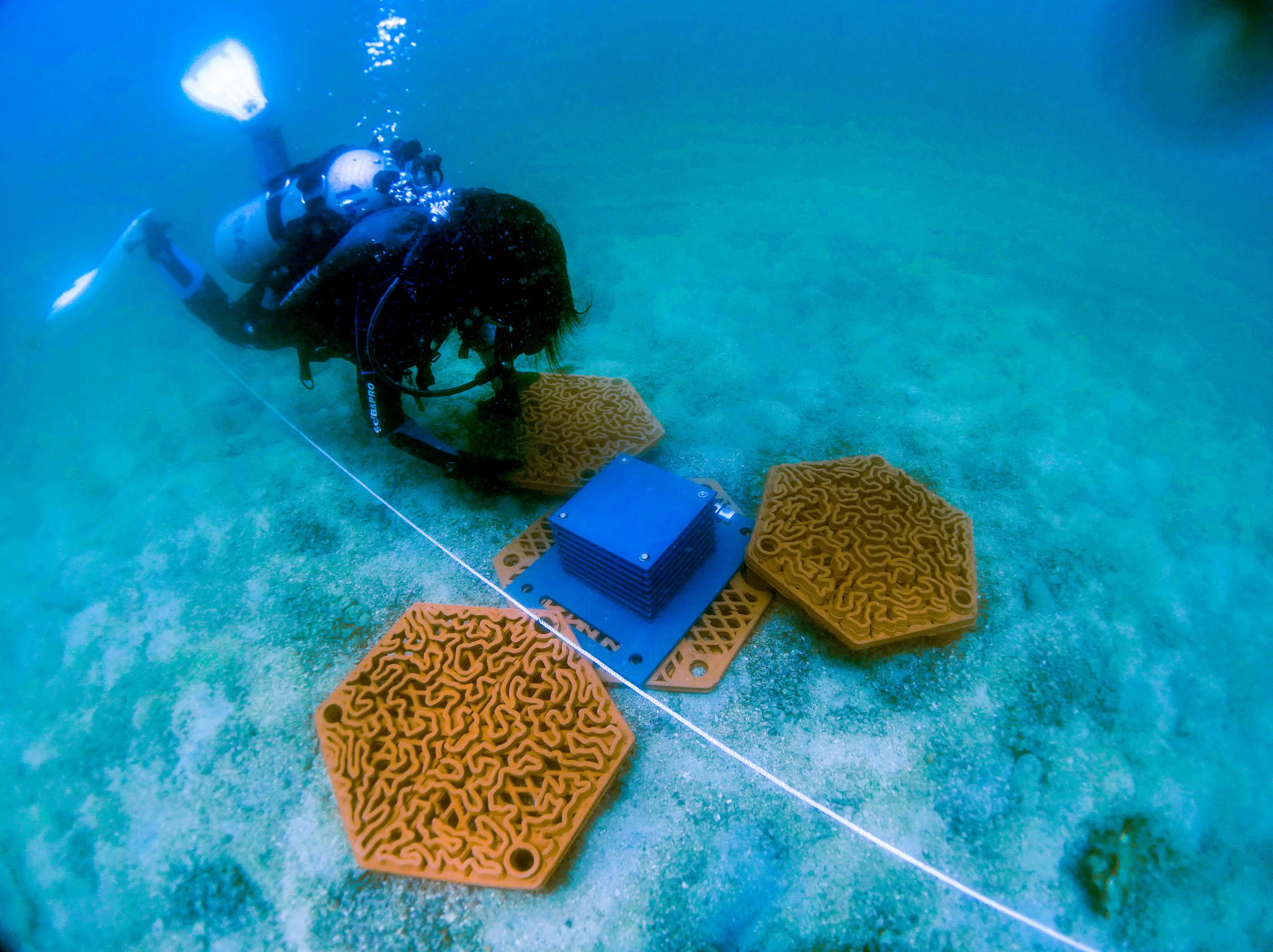
Archireef adjusts the shape of its reef tiles for each project.
“There’s no universal reef, so there’s no universal tile”, Yu says.
Instead of producing one standard model, the company adapts each design to the coral species, water conditions and surrounding marine environment. A coral restoration project in Hong Kong may therefore require a different tile from one in Saudi Arabia, even when the same manufacturing process is used.
“The biggest adaptation from site to site is usually the match between design, species and environment, not the manufacturing itself ”, Yu explains.
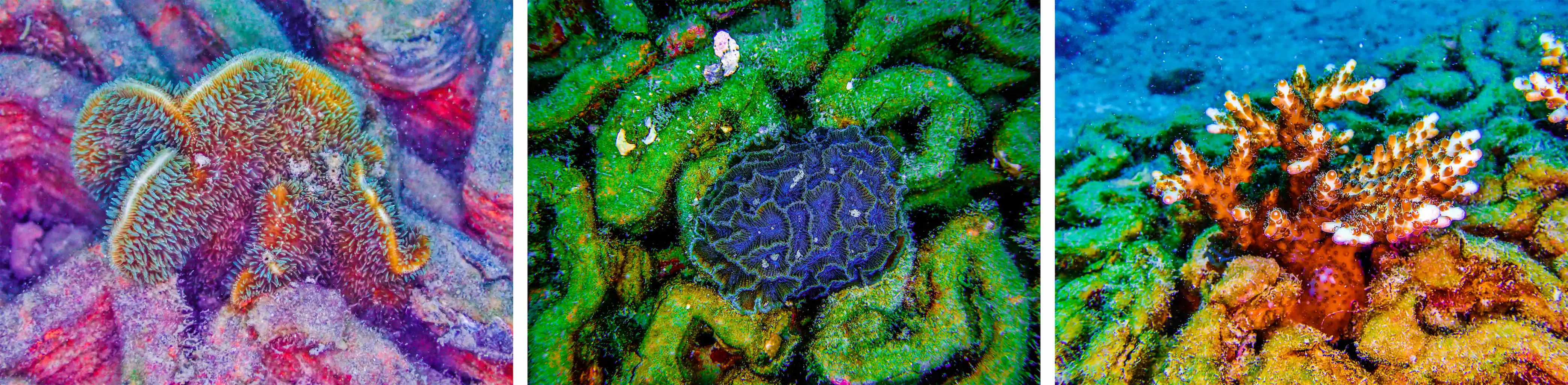
Although the reef tile is Archireef’s most recognizable innovation, Yu sees it as one part of a much broader service.
“The reef tile gets the attention because it’s tangible,” she says. “But the real product is the proof — defensible, audit-ready evidence of nature recovery that an organization can put in a disclosure and stand behind under scrutiny”.
Producing that evidence requires years of biodiversity monitoring. Long after the reef tiles have been installed, Archireef continues to track coral survival and the health of the surrounding marine ecosystem. Its monitoring methods include ecological surveys, AI-assisted species recognition, photogrammetry and environmental DNA testing.
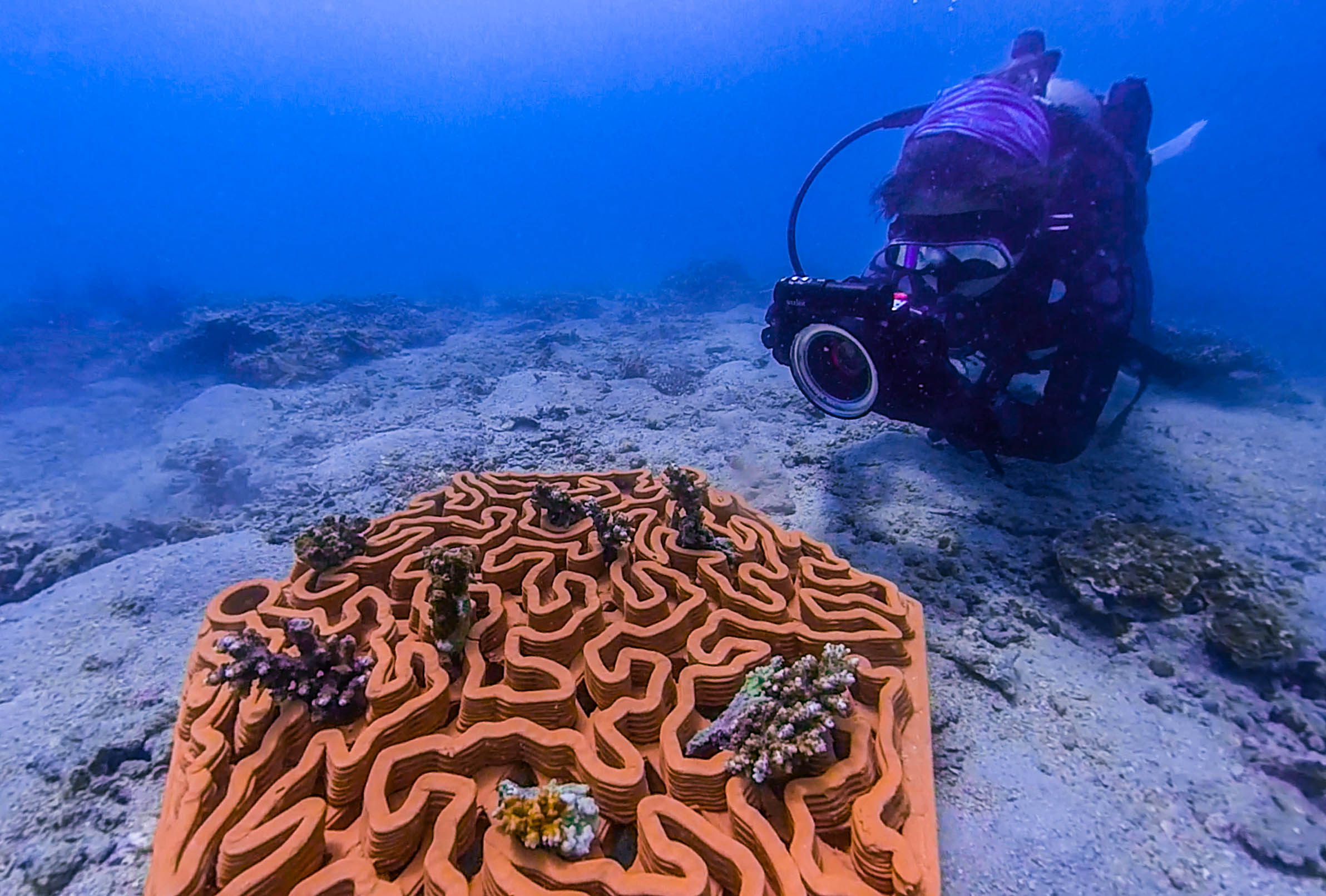
Photogrammetry uses photographs to produce detailed 3D models of the reef. These models allow the team to measure changes in coral growth and reef structure over time.
Environmental DNA, commonly known as eDNA, offers another way to monitor marine biodiversity. Traditional ecological surveys often depend on divers recording the species they can see. eDNA testing instead examines traces of genetic material left in the water by marine organisms, including skin cells, mucus and waste.
By analyzing these traces, Archireef can detect species that may be hidden, difficult to identify or absent during a dive. This gives the company a more complete picture of the ecosystem and how it is changing.
For Archireef, the success of a coral reef restoration project is determined by what happens several years after installation.
“The indicators that matter aren’t the ones that look good on deployment day”, Yu says. “They’re the ones that show, two, three and five years on, whether a genuine ecosystem is establishing and sustaining itself”.
At the company’s first restoration site in Hoi Ha Wan, Hong Kong, around 90% of the transplanted corals remained alive four years after deployment. The long-term survival rate suggests that the ecosystem is recovering rather than simply appearing healthy during the early stages of the project.
Results like these have helped Archireef move beyond academic research and secure collaborations across the public and private sectors. In Hong Kong, the company has worked with government departments and public organisations responsible for coastal infrastructure and marine conservation.