
Led by co-founders Andrew Raslan and Keyvan Jodeiri, Pipeline Organics is developing microbial fuel cells to help food and beverage manufacturers treat wastewater and recover energy as electricity.
Updated
November 16, 2026 12:32 PM

Concept visualisation of Pipeline Organics’ planned TankArc wastewater treatment and energy recovery system at a brewery. IMAGE: PIPELINE ORGANICS
A glass of beer or a bottle of soft drink leaves plenty behind before it reaches the shelf. Producing it requires water and electricity, then creates wastewater that manufacturers must pay to treat. For breweries and other food and beverage manufacturers working with tight margins, those bills can leave less money for new equipment, products and people.
Pipeline Organics, led by Andrew Raslan (commercial) and Dr Keyvan Jodeiri (technology), sees a resource in that waste. The Nottingham-based cleantech startup, Pipeline Organics, is developing microbial fuel cells that treat food and beverage wastewater while generating electricity. The aim is to help factories lower their operating costs by recovering value from a stream they already produce every day.
Founded in August 2021, Pipeline Organics grew out of the University of Nottingham’s Young Entrepreneurs Scheme, YES20. The founding team won its Engineering, Energy and Environment stream before establishing the company. Andrew, now CEO, brought a background in molecular microbiology and antimicrobial research, later moving into project management and commercialization.
Co-founder and chief scientific officer Keyvan Jodeiri brought a different piece of the puzzle. His research explored biofuel cells that could use sugars in blood to generate electricity for medical implants. The team began asking whether related principles could work outside the body, using organic material in industrial wastewater as fuel. Turning that idea into a business meant finding an application where the environmental benefits came with a clear financial incentive.
Food and beverage manufacturing offered that opportunity. Breweries and other food and beverage manufacturers produce wastewater rich in biodegradable organic material such as leftover carbs and fats or dead proteins, making it suitable food for microorganisms. Treating it at the factory also gives the company a more predictable waste stream than the mixture arriving at a general sewage treatment plant.
“What is filthy for you as a manufacturer is food for the bacteria,” Andrew explains.
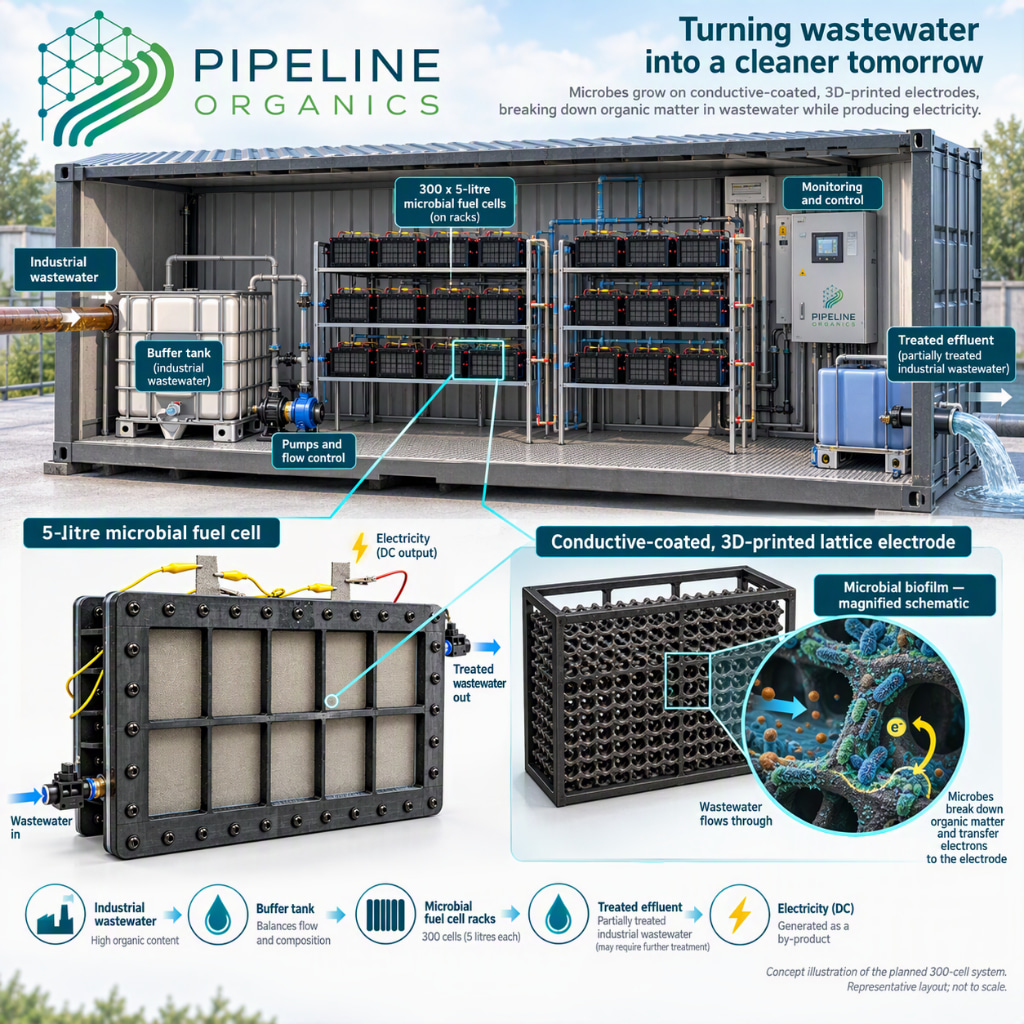
The company’s system, TankArc, contains reactors with specially designed, 3D-printed lattices. Microorganisms growing on the anode break down organic material in wastewater, releasing electrons that electrodes capture as electrical current. This reduces the organic pollution load while recovering some of its energy. Reactors can be grouped into racks or, eventually, containers equipped with plumbing, batteries and controls to serve different factory sizes.
Andrew describes the system as being designed to become self-powering, provided its electricity output scales as expected, with surplus energy available for use on site. At the moment, replacing a brewery’s entire electricity supply is beyond the immediate promise, Andrew admits. The more practical proposition is reducing the amount of power a manufacturer needs to buy through site efficiency upgrades, while cutting its wastewater treatment burden.
The treated wastewater would then go into the sewer for further treatment. Since it contains fewer pollutants, manufacturers could pay less in treatment charges or, in some cases, avoid them altogether. Pipeline Organics is also exploring ways to take the process further by working with partners to make water reuse possible. This could allow manufacturers to reuse the treated water for tasks that do not require high-purity water, such as post-production washing, which accounts for a large share of fresh-water use in the industry.
Much of TankArc’s engineering sits in the lattice itself. It needs sufficient surface area for the biological process while allowing wastewater to flow through without clogging. Different waste streams require different designs. Pipeline Organics combines engineering calculations with proprietary AI-assisted algorithms to adapt the geometry for applications such as beer, wine or fruit juice production.
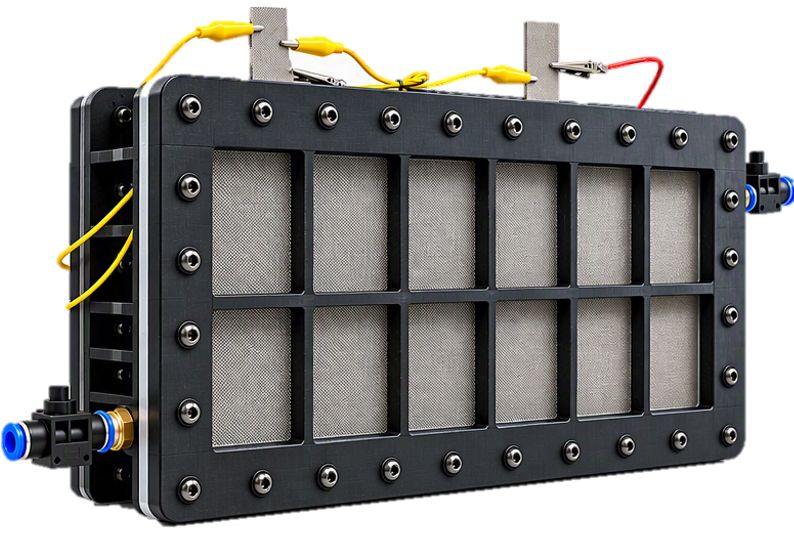
Andrew sees this design process as a competitive advantage. Once the geometry has been developed, components can be manufactured from the resulting 3D models. The difficult part is knowing how to design a cell that performs in a particular environment.
The company is competing with established wastewater treatment and energy recovery methods. Anaerobic digestion, for example, produces biogas that can subsequently generate heat and electricity. Pipeline Organics is pursuing direct electricity recovery through compact, modular equipment. Its suitability will depend on the site, the wastewater and the savings it can deliver.
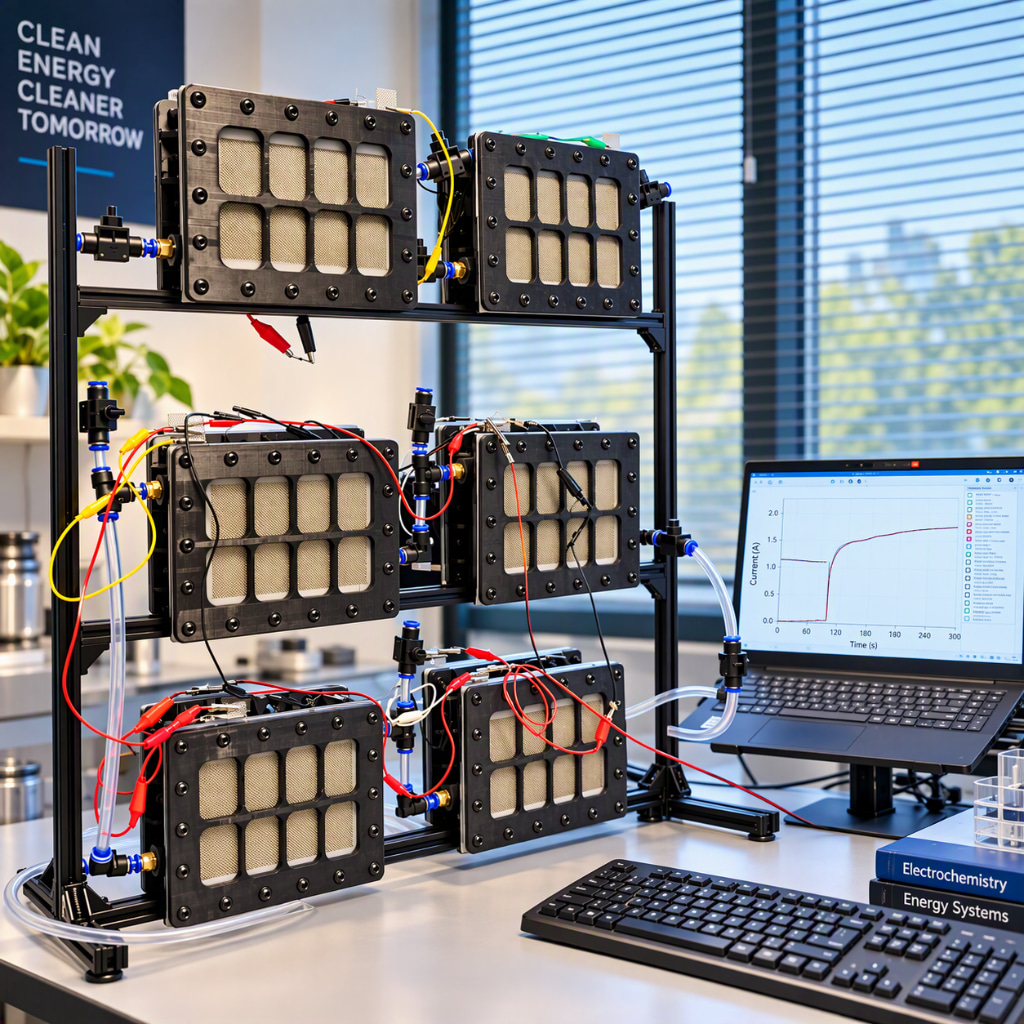
Early brewery trials have helped the team test those assumptions. At Little Ox Brewery, Pipeline Organics used a compact four-reactor system with real wastewater to assess compatibility and electrical output. The trial also provided practical lessons about monitoring, handling and operating equipment around a working production site. The company is working with Castle Rock Brewery in Nottingham as another development partner and have achieved onsite results that are close to commercial readiness.
These demonstrations represent an early step towards industrial deployment. During our interview, Andrew said Pipeline Organics had begun selling paid feasibility pilots that measure performance using customers’ wastewater under actual operating conditions. Larger reactor racks would be at the next stage, followed by containerised systems for facilities producing much greater volumes of effluent. They expect to deploy full-scale containers in 2027.
Scaling brings another set of challenges. The team is developing repeatable methods for producing conductive electrodes, maintaining wastewater flow and assembling larger systems. Reducing manufacturing costs while maintaining treatment performance is a central part of this work.
There will also be useful discoveries along the way: Chief Scientific Officer Keyvan says longer-term ambitions include developing the technology for wastewater sensing and exploring how recovered electricity could support electrochemical production of higher-value chemicals. These could open additional applications for the platform, while the immediate priority remains manufacturing and scaling the wastewater treatment system.
The proposed leasing model reflects the focus on customer economics. Manufacturers would rent equipment rather than purchase it upfront, retaining part of the savings after paying Pipeline Organics. Making that arrangement attractive requires dependable treatment, manageable maintenance and savings that hold up over time.
Andrew’s and Keyvan’s longer-term vision includes a wider portfolio of environmental technologies. For now, the next test is closer to the brewery floor: can the company turn promising small reactors into equipment food and beverage manufacturers can rely on?
“One man’s waste is another man’s raw material if you’re smart about it,” Andrew says. Pipeline Organics is building its business around that possibility, starting with the water left behind by a drink.
Keep Reading
Where Hollywood magic meets AI intelligence — Hong Kong becomes the new stage for virtual humans
Updated
February 7, 2026 2:18 PM

William Wong, Chairman and CEO of Digital Domain. PHOTO: YORKE YU
In an era where pixels and intelligence converge, few companies bridge art and science as seamlessly as Digital Domain. Founded three decades ago by visionary filmmaker James Cameron, the company built its name through cinematic wizardry—bringing to life the impossible worlds of Titanic, The Curious Case of Benjamin Button and the Marvel universe. But today, its focus has evolved far beyond Hollywood: Digital Domain is reimagining the future of AI-driven virtual humans—and it’s doing so from right here in Hong Kong.

“AI and visual technology are merging faster than anyone imagined,” says William Wong, Chairman and CEO of Digital Domain. “For us, the question is not whether AI will reshape entertainment—it already has. The question is how we can extend that power into everyday life.”
Though globally recognized for its work on blockbuster films and AAA games, Digital Domain’s story is also deeply connected to Asia. A Hong Kong–listed company, it operates a network of production and research centers across North America, China and India. In 2024, it announced a major milestone—setting up a new R&D hub at Hong Kong Science Park focused on advancing artificial intelligence and virtual human technologies. “Our roots are in visual storytelling, but AI is unlocking a new frontier,” Wong says. “Hong Kong has been very proactive in promoting innovation and research, and with the right partnerships, we see real potential to make this a global R&D base.”
Building on that commitment, the company plans to invest about HK$200 million over five years, assembling a team of more than 40 professional talents specializing in computer vision, machine learning and digital production. For now, the team is still growing and has room to expand. “Talent is everything,” says Wong. “We want to grow local expertise while bringing in global experience to accelerate the learning curve.”


Digital Domain’s latest chapter revolves around one of AI’s most fascinating frontiers: the creation of virtual humans.
These are hyperrealistic, AI-powered virtual humans capable of speaking, moving and responding in real time. Using the advanced motion-capture and rendering techniques that transformed Hollywood visual effects, the company now builds digital personalities that appear on screens and in physical environments—serving in media, education, retail and even public services.
One of its most visible projects is “Aida”, the AI-powered presenter who delivers nightly weather reports on the Radio Television Hong Kong (RTHK). Another initiative, now in testing, will soon feature AI-powered concierges greeting travelers at airports, able to communicate in multiple languages and provide real-time personalized services. Similar collaborations are under way in healthcare, customer service and education.
“What’s exciting,” says Wong, “is that our technologies amplify human capability, helping to deliver better experiences, greater efficiency and higher capacity. AI-powered virtual humans can interact naturally, emotionally and in any language. They can help scale creativity and service, not replace it.”
To make that possible, Digital Domain has designed its system for compatibility and flexibility. It can connect to major AI models—from OpenAI and Google to Baidu—and operate across cloud platforms like AWS, Alibaba Cloud and Microsoft Azure. “It’s about openness,” says Wong. “Our clients can choose the AI brain that best fits their business.”
Establishing a permanent R&D base in Hong Kong marks a turning point for the company—and, in a broader sense, for the city’s technology ecosystem. With the support of the Office for Attracting Strategic Enterprises (OASES) in Hong Kong, Digital Domain hopes to make the city a creative hub where AI meets visual arts. “Hong Kong is the perfect meeting point,” Wong says. “It combines international exposure with a growing innovation ecosystem. We want to make it a hub for creative AI.”
As part of this effort, the company is also collaborating with universities such as the University of Hong Kong, City University of Hong Kong and Hong Kong Baptist University to co-develop new AI solutions and nurture the next generation of engineers. “The goal,” Wong notes, “is not just R&D for the sake of research—but R&D that translates into real-world impact.”

The collaboration with OASES underscores how both the company and the city share a vision for innovation-led growth. As Peter Yan King-shun, Director-General of OASES, notes, the initiative reflects Hong Kong’s growing strength as a global innovation and technology hub. “OASES was set up to attract high-potential enterprises from around the world across key sectors such as AI, data science, and cultural and creative technology,” he says. “Digital Domain’s new R&D center is a strong example of how Hong Kong can combine world-class talent, technology and creativity to drive innovation and global competitiveness.”
Digital Domain’s story mirrors the evolution of Hong Kong’s own innovation landscape—where creativity, technology and global ambition converge. From the big screen to the next generation of intelligent avatars, the company continues to prove that imagination is not bound by borders, but powered by the courage to reinvent what’s possible.