
Discus Fish of Cobo and Samuel Tse of Animoca Brands discuss how AI agents, digital identity and blockchain could change the way money moves.
Updated
November 2, 2026 12:03 PM
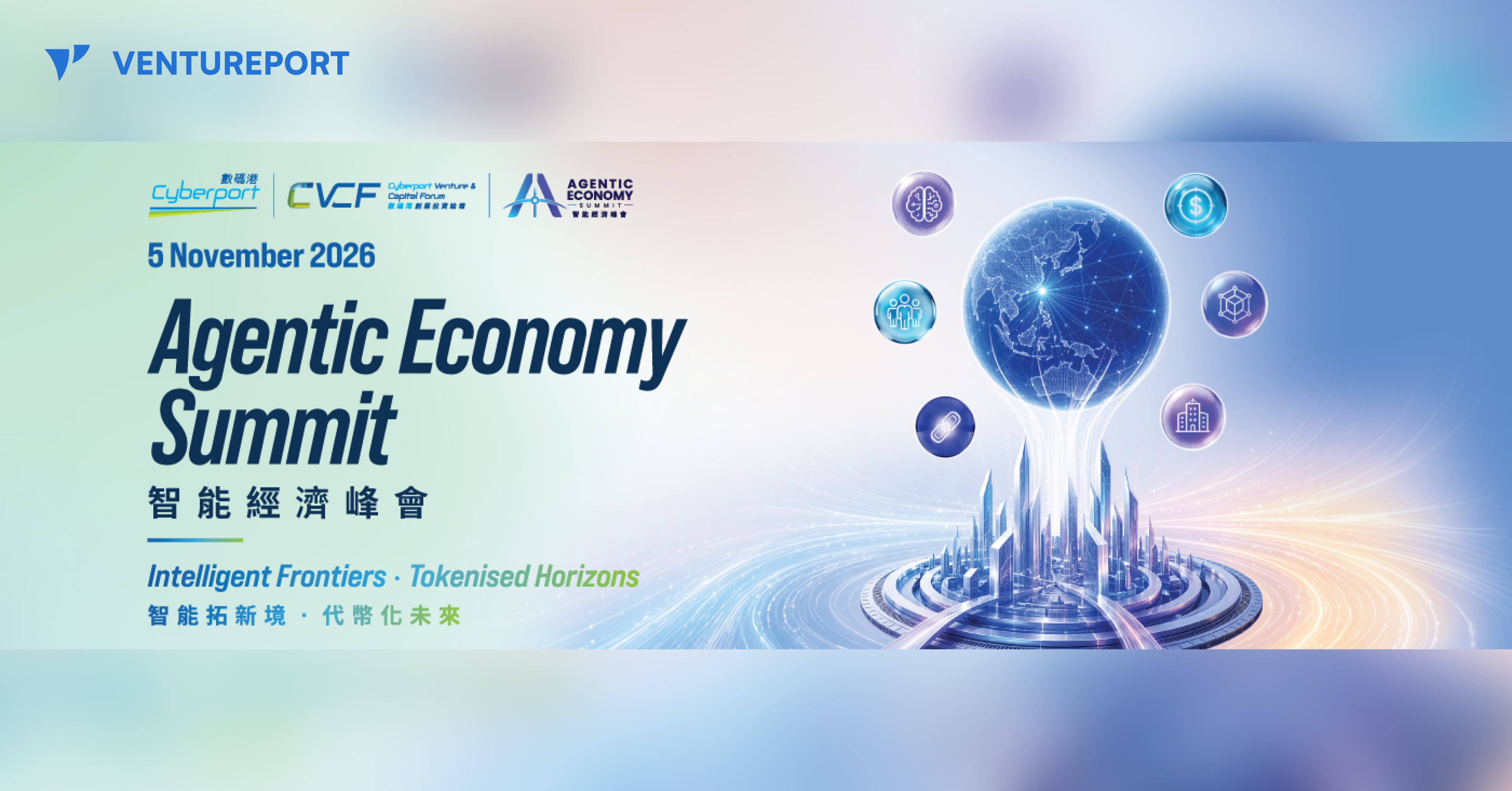
The Agentic Economy Summit at CVCF 2026 explores how AI agents and digital assets could shape the future of business and finance. IMAGE: CYBERPORT
For an AI agent to manage money on someone’s behalf, it needs more than the ability to follow instructions. It must be able to establish whom it represents, access funds and transact within agreed limits.
These are among the questions informing the discussion of AI and digital assets at Cyberport Venture Capital Forum (CVCF) 2026. Ahead of the forum, Discus Fish, CEO and Co-founder of Cobo, and Samuel Tse, Head of Investment and Corporate Finance at Animoca Brands, shared their views on how this convergence could develop—and where they see opportunities for businesses.

Discus Fish points to a longstanding challenge: blockchain can be difficult for everyday users to navigate, but AI agents may find it easier to interact with these networks.
“Blockchains have always been hard for ordinary people to use. AI agents may be better users: the chain is fully transparent and every record is traceable, which suits agents well.”
His outlook comes with a qualification. Both the agents and the networks they would use still need to develop.
“Agents aren’t capable enough yet, and chains are still adapting. But once agents truly run on-chain, the number of users and what’s possible will grow by an order of magnitude.”
Discus Fish says blockchain could reshape how financial assets are issued, traded and settled over the next five years. He also notes that institutional adoption has progressed faster than Cobo initially expected, with individual users no longer leading the shift. “Since 2017, we have believed blockchain will become part of the financial infrastructure of the future. We expected individual users to lead, but institutions moved faster.”
For Fish, the next stage involves a broader range of assets and financial clients.
“What gets redefined next is how assets are issued, traded, and settled. As traditional assets like US equities come on-chain, a much wider range of financial clients will follow.”

Samuel Tse, Head of Investment and Corporate Finance at Animoca Brands, focuses on investment opportunities across digital assets and agentic AI. He sees digital identity as essential to allowing AI agents to act on behalf of people while keeping transactions within the permissions they set.
He believes users should set clear rules for what an AI agent can do, allowing it to complete transactions without requiring approval for each one.
“Once agents can prove who they represent, hold digital assets, and move value under clear rules, the economy stops being click-by-click. You set the policy once—who, how much, for what—and the agent transacts inside it.”
He describes applications ranging from everyday payments and transfers to subscriptions, swaps and earning returns on idle funds. “That’s agentic transactions: payments, transfers, subscriptions, swaps, even chasing a better rate on idle cash. Identity is the trust layer. Assets and credentials are the spending authority—always accountable to the human who granted permission.”
In Tse’s account, the human remains the source of that authority. The agent acts within the permissions granted to it.
To illustrate how AI agents, digital identity and digital assets might work together, Tse offers a hypothetical Hong Kong parent's weekday.
“A Hong Kong parent’s weekday: top up the child’s Octopus, book a weekend football slot, translate a school notice for the helper, check weather before pickup, restock milk at the member price, and keep leftover budget earning until tomorrow.”
At present, he says, completing these tasks requires navigating services that often operate separately.
“Today that means many apps that don't talk to each other, and rails that struggle with micro payments.”
His proposed alternative brings the tasks together under instructions established by the user.
“With an agent, they set the rules once and let it decide what to do. Identity unlocks trust and member prices without oversharing. Digital assets fit the money—per-use fees, hard limits, yield until spend.”
For Tse, this combination could create opportunities across payments, merchants, identity providers and digital-asset platforms. He compares the potential scale of agentic commerce to an earlier change in how consumers accessed services.
“The iPhone in 2007 rewired how people buy and use services for 20 years. We are just at the beginning of a similar paradigm shift, with outcomes we can barely imagine.”
Discus Fish and Samuel Tse offer two perspectives on the emerging agentic economy, from the blockchain infrastructure enabling transactions to the digital identity and permissions that allow AI agents to act on people's behalf. At CVCF 2026, these ideas will become part of a wider conversation with the leaders building and investing in this evolving space.
Be part of the conversation. Join industry leaders, founders and investors at CVCF 2026 on 4–5 November and explore the technologies and opportunities shaping the next phase of business.
Exclusive for Ventureport readers: Use code cvcf26vp to access a Full Access Pass for HK$300, subject to confirmation by the organiser.
Keep Reading
A new bet on early heart failure detection and why women’s health is at the center.
Updated
January 8, 2026 6:28 PM

A doctor holding an artificial heart model. PHOTO: ADOBE STOCK
Heart disease does not always announce itself clearly, especially in women. Many of the symptoms are ordinary, including fatigue, shortness of breath and swelling. These signs are frequently dismissed or explained away. As a result, many women are diagnosed late, when treatment options are narrower and outcomes are worse. That diagnostic gap is the context behind a recent investment involving Ultromics and the American Heart Association’s Go Red for Women Venture Fund.
Ultromics is a health technology company that uses artificial intelligence to help doctors spot early signs of heart failure from routine heart scans. It has received a strategic investment from the American Heart Association’s Go Red for Women Venture Fund.
The focus of the investment is a long-standing blind spot in cardiac care. Heart failure with preserved ejection fraction, or HFpEF, affects millions of people worldwide, with women disproportionately impacted. It is one of the most common forms of heart failure, yet also one of the hardest to diagnose. Studies even show women are twice as likely as men to develop the condition and around 64% of cases go undiagnosed in routine clinical practice.
Ultromics works with a tool most patients already experience during heart care: the echocardiogram. There is no new scan and no added burden for patients. Its software analyzes standard heart ultrasound images and looks for subtle patterns that point to early heart failure. The goal is clarity. Give clinicians better signals earlier, before the disease advances.
“Heart failure with preserved ejection fraction is one of the most complex and overlooked diseases in cardiology. For too long, clinicians have been expected to diagnose it using tools that weren't built to detect it and as a result, many patients are identified too late,” said Ross Upton, PhD, CEO and Founder of Ultromics. “By augmenting physicians' decision making with EchoGo, we can help them recognize disease at an earlier stage and treat it more effectively.”
The stakes are high. Research suggests women are twice as likely as men to develop the condition and that a majority of cases are missed in routine clinical practice. That delay matters. New therapies can reduce hospitalizations and improve survival, but only if patients are diagnosed in time.
This is why early detection has become a priority for mission-driven investors. “Closing the diagnostic gap by recognizing disease before irreversible damage occurs is critical to improving health for women—and everyone,” said Tracy Warren, Senior Managing Director, Go Red for Women Venture Fund. “We are gratified to see technologies, such as this one, that are accepted by leading institutions as advances in the field of cardiovascular diagnostics. That's the kind of progress our fund was created to accelerate.”
Ultromics’ platform is already cleared by regulators for clinical use and is being deployed in hospitals across the US and UK. The company says its technology has analyzed hundreds of thousands of heart scans, helping clinicians reach clearer conclusions when traditional methods fall short.
Taken together, the investment reflects a broader shift in healthcare. Attention is shifting earlier—toward detection instead of reaction. Toward tools that fit into existing care rather than complicate it. In this case, the funding is not about introducing something new into the system. It is about seeing what has long been missed—and doing so in time.